الأربعاء، 30 ديسمبر 2015

How The Big Farms Do It: From The Hatchery to The Shop

Well, the journey to the millions that big poultry farms make isn’t quite a walk in the park. However, it is nothing like rocket science and with a little determination you too can scale great heights in poultry farming. This short article gives a detailed procedure as followed in top farms around the world.

Hatchery to farm
Newly hatched chicks are transported to broiler farms, in ventilated chick boxes, in air-conditioned trucks that are specifically designed to carry chicks. It is important that chicks receive feed, water and warmth soon after hatching, however the remains of the yolk sac can sustain each chick for up to 72 hours post-hatch.

Brooding or Starting
On arrival at the broiler farm, day-old chicks are placed onto the floor of the shed, where they are initially confined to an area of between a half to one third of the total shed area (the ‘brooding area’) and given supplementary heating from gas heaters or heat lamps (referred to as brooders) for about three weeks. This period of time is called brooding. Extra feed pans and water dispensers are provided in the brooding area, and the bedding may be partly covered with paper to stop dropped feed from getting into the bedding and spoiling. Both male and female chicks are reared as meat chickens. While the flocks are usually of mixed sex, some operations may grow male and female chickens separately, depending on market requirements. For example, one company grows out only male chickens in one area, allowing its operations and processing plant in that area to be geared up specifically for larger birds, while sending female chicks to another area.

The air temperature under the brooder should initially be 35oC and reduced by 1-2oC per day until it reaches 23oC when the chickens are approximately three weeks of age. Sophisticated brooding systems have been developed which include gas-fired radiant heat sources, through gas-fired hot air blasters, and fully controlled environment sheds with special heated air passed through ducts to the chickens. High protein (22%) starter rations are fed to young meat chickens to ensure they grow as much as possible early in life. This may be continued for 18-24 days. A medicine, called a coccidiostat, is added to the feed of meat chickens to prevent the intestinal disease coccidiosis. Australian meat chickens are raised on litter floors, but some overseas companies use wire-floored cage systems. The number of chickens in a meat chicken shed is usually high, with some Australian sheds containing up to 30 000 meat chickens.

Growing or Finishing
At this stage, growth is still very important, but since feed is expensive careful costing is carried out to keep expenses to a minimum. Thus a diet that is lower in protein (19%) is fed to the chickens for the remainder of their life (usually until 42 days of age). Heavy weight birds that are required for chicken fillets are slaughtered at up to 56 days of age. A coccidiostat, sometimes a different one from that used in starter feed, is added to the finisher feed. Some meat chickens go through a separate rearing stage, with a special rearing ration being fed to them before they are placed on a finisher feed, but most go straight from starter to finisher feed.

Harvesting
Getting finished meat chickens from the farm to the factory is a delicate business. Most catching is done at night when the birds are quieter, and this also gets them to the processor early in the morning with less delay before slaughter. Delay means stress and weight loss. Mechanical devices for harvesting meat chickens have been invented, however results are variable and most Australian meat chickens are still caught by hand. Birds are placed into plastic crates or aluminium modules designed for good ventilation and safety from bruising during transport. These crates or modules are handled by specialist forklift equipment and loaded onto trucks for transport to the processing plant. In Australia, a percentage of chickens are harvested at up to four different times depending on the need for light or heavy birds. Harvesting is also know n as ‘partial depopulation’, ‘thinning out’, or ‘multiple pick-up’. Thinning out sheds allows more space for the remaining birds and reduces the natural temperatures in the shed. The first harvest can occur as early as 30-35 days and the last harvest at 55-60 days.

Shed clean-out

Broiler processing is highly mechanised
Once all the birds have been harvested (after approximately 60 days), the shed is cleaned and prepared for the next batch of day old chicks, which generally arrives five days to two weeks after the previous harvest. Not only does is the time between batches used to clean the shed, but it also reduces the risk of common ailments being passed between batches as many pathogens die off in this time. Many farms undertake a full cleanout after every batch. This involves removing bedding, brushing floors, scrubbing feed pans, cleaning out water lines, scrubbing fan blades and other equipment, and checking rodent stations. High pressure hoses clean the whole shed thoroughly. The floor bases are usually rammed earth and because low water volumes are used, there is little water runoff.

Once the shed has been thoroughly cleaned, it is disinfected. This is carried out using low volumes of disinfectant sprayed throughout the shed. If insects, such as beetles, were a problem in the previous batch an insecticidal treatment may also be used. Any disinfectant or insecticide that is used must be approved by the Australian Pesticide and Veterinary Medicines Authority (APVMA) as safe and fit for use in broiler sheds. After a full cleanout, company veterinarians or servicemen will test the shed to confirm that it has been adequately cleaned and any potential disease agents removed. Sometimes, a partial shed cleanout only is required which involves removing old litter and / or topping up fresh litter and cleaning and sanitising equipment. However, a full cleanout is done after every second or third batch of chickens.

Processing line

When chickens arrive at the processor they go through the following sequence:
  • Hung by the legs on a shackle
  • Stunned using an electrically charged water bath
  • Killed by cutting the blood vessels in the neck
  • Bled so that most of the blood leaves the carcass
  • Scalded to soften the attachment of the feathers
  • Plucked to remove the feathers
  • Head removed
  • Gutted or eviscerated to remove the internal organs
  • Washed to remove blood and soiling from the carcass
  • The hock is cut to remove the feet
  • Chilled to prevent bacterial spoiling
  • Drained to remove excess water from the carcass
  • Weighed
  • Cut selection to divide the carcass into the desired portions (breast, drumsticks etc.)
  • Packed in plastic bags to protect carcasses or portions
  • Chilled or frozen for storage

Removal of breast meat
The carcasses are graded during the processing sequence to remove poor quality meat. This meat is used for cut-up (further processing) purposes or, if badly affected, might be used for pet food or condemned and cooked to be made into meat meal for stock feed.

Further Processing and storage
Further processing includes cutting up the carcasses into portions, deboning carcasses and preparing special ready-to-cook products. Cooking is an additional process which is carried out at some processing plants. Almost all chicken meat is sold chilled. Chilled chicken meat must be cooked before it spoils. The shelf life of chicken meat is usually eight to 12 days, depending on the processing, handling and storage conditions.

Marketing
In Australia most chicken is sold under the brand name and market competition is very strong. The average amount of chicken eaten has risen rapidly as prices have fallen. These changes have taken place at the expense of the beef and lamb industries.

الجمعة، 4 ديسمبر 2015

Omondi’s 2000-Plus Chicken Empire Is Just A Side Hustle: His Dreams Are Bigger!

Dressed in a white overcoat, a black trouser and gumboots, Nicholas Omondi digs his hand in a sack of poultry feeds and offers his birds at his farm in Dunga, Kisumu.

The farmer keeps 42 ornamental birds that include silky and bantam chickens, doves, guinea fowl and fantail pigeons.

But these are just to beautify his one-and-a-half acres Victoria Eco-Farm. His mainstay are the Kari Kienyeji, Rainbow Rooster and Kuroiler chickens, all which total 2,000, excluding the chicks.

He hatches eggs from the chickens in 15 incubators. “I have two incubators with a capacity of 10,000 eggs. The rest have a capacity of between 2,500 and 8,000 eggs,” says the poultry farmer.

Every three days, he collects over 6,000 chicks for sale. “When they leave the hatchery, I pack them in boxes and deliver to our clients in Kisumu and other counties, including Nairobi.”

Omondi sells to other farmers the day, a week, two weeks, a month and two months old chicks.

A day-old chick goes for Sh85, a week-old at Sh120, two weeks at Sh150, a month at Sh250 while two months chicks go for Sh400.

On the other hand, he sells a mature breeding cockerels for Sh1,500 each.

“The best hen to cockerel ratio in poultry breeding is 1:7. Most farmers over-work their cockerels and this lowers the quality of eggs and, thus, chicks.”
He sells mature bantam and Italian silky chickens at Sh13,000 when they are four months old, mostly to the Asian community.

With contracts from several outside catering firms, the farmer in a good week supplies 1,500 mature birds for events such as funerals and weddings at an average of Sh1,000.

The 35-year-old collects 1,800 eggs per day. He further sources from farmers to ensure he does not run out of the fertilised eggs to hatch.

“We are encouraging contract farming. We have farmers who buy our chicks, once they start laying eggs, we buy back the fertilised eggs from them,” says Omondi, who works with over 100 farmers in different counties.

Interestingly, his poultry business is a ‘side hustle’ as Omondi works as a journalist at Radio Lake Victoria where he presents an evening show.

So how did he built his poultry empire? “I started the business in 2008 with a capital of Sh250,000 from my savings. I really wanted to keep poultry with the passion making me to save nearly every coin I made.”

He used Sh40,000 to buy 50 mature Kienyeji birds comprising of 40 hens and the rest were cockerels. He spent Sh15,000 on feeds in three months and Sh187,000 went to the construction of a one-storey poultry house.

With time, his brood increased as he expanded his hatchery using skills he picked in trainings and seminars sponsored by the USAID, Plan International and others NGOs.

Each day, the father of two, who doubles up as the farm manager, starts his day at 5am by feeding the birds with the help of his workers as he monitors if they have any diseases before leaving for work later in the day.

“We formulate our own feeds from maize germ, cotton seed cake and fishmeal (omena). I add in the feeds coccidiostat and mineral supplements to curb diseases. In a day, we use 12 50kg bags of feeds,” explains Omondi, who has six workers.


He says the few the number of workers in a poultry farm, the more efficient work is done and overall farm management.

His main challenges include diseases like Newcastle, gumboro and fowl pox, which in many cases strike when he is least prepared.

“Each year, I must lose some birds to these diseases. It happens to every farmer before they identify the disease and take preventive measures,” says Omondi, whose dream is to be the biggest supplier of chicks and other poultry products in western Kenya.

Amos Amenya, an agronomist at the Lake Basin Development Authority, while using a charcoal brooder, one should guard against suffocation due to carbon-monoxide.


“For chicks, Gumboro vaccine should be administered when they are a day-old. After 14 days, the chicken should be vaccinated against Newcastle Disease followed by small pox.”

الجمعة، 2 أكتوبر 2015

Grab The Opportunity To Make Big Money With Kienyeji Chicken Now: Learn From Regina’s Success

Chicken is one component of those meals we love to prepare. For a long time, we were used to the broilers sold in most hotels and fast food points. However, those who know how the birds are bred and feed will tell you that you would rather buy kienyeji chicken.  As more Kenyans realize this, the demand for these chicken has over the last few years increased tremendously. This is the opportunity that Regina saw and tapped into to make a kill.

Regina started her business in 2009 with 2 hens and a cockerel. Today she has more than 100 layers and breeding cockerels and can hatch more than 700 chicks in a month, using her incubator. Here are a few tips that we got from Regina that might help you to commercialize your indigenous poultry project like she did.

Hatching Chicks Using an Incubator
Regina has an incubator that has a capacity of 750 eggs. The incubator operates on electricity but can also be powered by the use of a generator or solar energy. She also has invented a cheap way of providing the eggs with warmth incase of power loss. "I boil water and put it in 5-litre jericans which I place in the incubator. I change the water with freshly boiled after every three hours. This to keep the incubator warm," She explained. Incubated eggs hatch after 21 days. The egg to chick turnover is directly attributable to the layers and how the eggs were handled.

Choice of Layers and Handling of Eggs
Below are some of the best practices in selection and handling of incubating eggs.
Layers of incubating eggs should be served by cockerel at the rate if 1 cockerel for 10 hens to ensure that the eggs are fertilized.
Incubating eggs should be incubated not more than two weeks after being laid. The more the eggs are kept before being incubated, the more you reduce hatching probability.
The eggs should be kept in well aerated places before being incubated. This is to ensure good supply of air to the York.
Eggs should be handled with clean hand and well labeled to ensure that openings in the shell are left open. Eggs should not be handled with oily hands as this may cause the York to suffocate.

Handling Young Chicks
After hatching, young chicks should be placed in brooders; structures that are well aerated and regulated heat to keep the chicks warm. Chicks should be kept in brooders for up to two months when they have fully developed wings.

Feeding
Chicks should be fed with broiler starter marsh for up to eight weeks as they are easily introduced to other types of food that are more traditional such as grains and food leftovers. The good thing is that kienyeji chickens are hardy and once fed in the morning, they spend the rest of the day scavenging for food outside.

Maturity
If well fed and taken care of, the indigenous chicken matures in between four to five months and hens start laying eggs.

Diseases
Kienyeji chicks are resistance to diseases though it is advisable that you vaccinate them and also give them antibiotics regularly.

Marketing
Indigenous chickens have a large unsatisfied market in Kenya. According to Regina, she is not able to satisfy the demand for chicks that she receives. "Marketing of kienyeji chicks is not a problem. They are usually ordered before they hatch", she explained. "Chicks that are left to grow to maturity are used as layers and fetch between Kshs. 1000 to Kshs. 1200 in Nairobi", she added.
Fertilized eggs are sold for between Kshs. 15 to 25 depending on where you are buying them.

Now that is a great opportunity to make huge profits. 

الثلاثاء، 15 سبتمبر 2015

How Caleb Karuga Overcame Major Handles To Build A 800K Chicken Empire


Immediately after he was forcefully retrenched from his TV job at K24 in 2013, Caleb Karuga ventured into poultry farming. Two years later, he has no regrets to boot. In fact, the founder and CEO of Wendy Farms Limited has gone on to build a poultry empire that rakes in over Sh. 800,000 from KARI Kienyeji Chicken, and trainings of other farmers.

However, his journey into successful poultry farming has not been a walk in the park. When Karuga first ventured into farming he acquired 200 pigs because pigs were the ‘it’ thing at the time. With no proper research, the venture failed.

He made another attempt, buying two hens and one cock. “When the two hens started laying eggs I decided to buy more hens from neighbouring farms. That was my biggest mistake because some of the hens were not vaccinated. In a span of about one month and a half, I had lost about 200 hens. I learned that you should never buy birds that you are not sure whether or not they have been vaccinated.”

Not one to give up easily, Karuga purchased 500 day-old chicks from the Kenya Agricultural Research Institute, but once again made loses as his employees sold the chickens in his absence.

“Theft by employees was the major challenge we have faced. I bought the chicks at KSh. 100 each and after a month of feeding them my employees were selling them off for KSh. 50 each. When they matured I would be told the hens had ‘died’ of diseases.”
 
Caleb Karuga Trainings
Karuga, nevertheless, soldiered on and bought another 1,500 chicks, but because he used cheaper feed, egg production was poor. Eventually Karuga realized that he would make three times more selling day-old chicks than what he was making selling eggs. “I learned that in indigenous chicken farming the money is in day-old chicks, not eggs. It was like a light bulb moment for me. I realized that I had been sitting on a gold mine.”

Today, Mr. Karuga has chicken farms in Kikuyu, Nyeri and Nanyuki. Although the Kienyeji chicken take longer to mature, Mr. Karuga chose them because they are cheaper to feed and are quite disease resistant. “I sell a one day chick at Sh 100 and a kienyeji egg at Sh 15 or Sh 20. A full grown Kienyeji chicken goes for about Sh 800 while the broilers/ ex layers go for Sh 270-Sh 300. When you do your maths, you realize that the Kienyeji chicken is more profitable,” quips the former TV reporter.

At times, he sells cocks at Sh 1,200 and above during holidays such as April, August and December. “In most cases, I determine the cost of the chicken since the demand for Kienyeji meat far outstrips supply. It’s a very good business.”

On a good month, Caleb says the Kienyeji chicken can earn him a handsome figure in the neighborhood of 600,000 shillings or more. He charges his trainings at Sh. 1,000 per person per session.

“I don’t regret having left employment, God has been very faithful to me despite the challenges I face every day,” he says. “You cannot satisfy demand for Kienyeji chicken in Kenya, East African region and the rest of Africa. As matters stand, the orders I have for day-old KARI Improved Kienyeji Chicken and Kuroilers is overwhelming me, but I am not complaining.”

Despite his initial losses, Karuga says he has learnt a lot along the way. “I believe in going through the learning curve. When a venture fails I don’t take it personally. It is the business that has failed, not me. I might have made a mistake but I choose to keep on the ball. I don’t make permanent decisions based on temporary situations.” While it is encouraging to see more young people going into agribusiness, Karuga says the industry should not be romanticised.

“What we are seeing is people going into farming because they read a story in a newspaper. They don’t do thorough research and they have no passion for farming, but because it seems sexy they decide to take a loan and bury the money. Don’t make farming sexy because it is not.” He warns that anyone looking to get into agribusiness needs to first have a passion for it. “If your only motivation is to make money then you are getting into the wrong business.”

Kwa kweli vijana tunaweza make doh na farming

الأحد، 30 أغسطس 2015

I Have Market for Eggs, Where Are the Farmers?

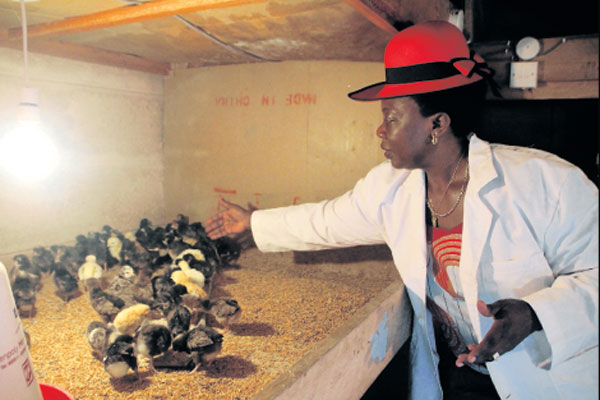
Dressed in a white overcoat, gumboots, red dress and a matching cap, Rose Nyamunga scoops fish feeds from a bucket and sprinkles them in a fish pond. The fish scramble for the feeds.

Nyamunga, the Kisumu Woman Representative, owns the two-acre fish farm on the outskirts of Kisumu town. The farm has six hatcheries, 10 fish ponds and several breeding cages. “Welcome to my fish farm,” says a cheerful Nyamunga.

The catchiest thing is that the politician has a poultry farm, says she started the farm in 2013 with the help of her husband after realising the bulk of fish and eggs consumed in the region were from Uganda. Most traders in the county import the items from the neighbouring countries through Busia and Serare border points because of low supply.


“It pained me that we were importing things that we can produce locally. My aim of starting the ventures, particularly the poultry business, was to try and provide local farmers with affordable but quality chicks to boost poultry farming,” says Nyamunga of the business that she invested over Sh4 million, most which went to buying incubators.

Besides the incubators, she further bought 5,000 fertilised eggs for hatching to get started. However, she has since contracted over 100 farmers keeping Kari indigenous chickens who supply her with fertilised eggs.

“We buy the eggs at Sh30 each, which is higher than the market price but still I have a huge deficit. All my 11 incubators have not operated optimally since I started,” she says.

Nyamunga only hatches 4,000 eggs yet she has a capacity of 40,000 after every 21 days. “I am really in need of fertilised eggs to hatch because I want to empower our farmers. If there is a farmer out there with the quality I want, then he should supply me.”

She sells the chicks to farmers at Sh85 instead of Sh120 market price. Bernard Otieno is among farmers who have benefitted from the low-cost chicks. He keeps over 900 chicks at his home in Kisumu. “We pick the chicks after they have been vaccinated which helps in cutting costs,” says Otieno, who sells eggs.

Nyamunga says if the poultry and fish sectors are given the attention they deserve across the country, they can uplift the livelihoods of thousands of people.

“As Kisumu, we can export the eggs and fish to other counties and even to Tanzania and Uganda if people rear chickens and keep fish. Fish from Lake Victoria has dwindled thus we must embrace ponds,” says Nyamunga, who sells only male tilapia fingerlings to farmers at Sh3 each, instead of Sh5.

Most farmers, according to her, prefer the male fingerlings because they grow faster and do not divert energy into reproduction.

“I hatch both the male and female fingerlings but after birth, we place them in caged ponds where we reverse the female ones into male using feeds. The process takes 42 days, enabling us to have between 10,000 and 30,000 fingerlings after every two weeks.”

“On average, I sell over 20,000 fingerlings every month to farmers but demand is still double that amount,” she adds of the project that has so far reached 20 groups.

The poultry project, on the other hand, she says has reached 1,500 farmers but her aim is to cover the entire county, and if possible neighbouring ones. She says that being in farming helps her spend time wisely when she is not attending to political matters as she reaches out to farmers who have bought her fingerlings and eggs.

“I know my projects can make a difference but I cannot do everything on my own. As I struggle to offer farmers chicks and fingerlings at subsidised price, the county should help me in reviving the ponds and promoting poultry farming.”

By ANGELA OKETCH

الثلاثاء، 25 أغسطس 2015

The Greatest Mind In Agribusiness I Have Met So Far: Simon Mbuto

This place looks ordinary, just like any other by-the-road establishment along the winding Nairobi-Nakuru highway. Its name too is kept so simple one can easily think “…ABC? The guy must have run out of ideas.”

For a long time I passed through this place without taking any keen interest in it. During one of my chats about agribusiness, a friend asked whether I knew ABC. I struggled to remember where I had seen it, which I had to because she seemed too ready to get disappointed if I didn’t. “I would like you to meet him.” The way that was said sparked great curiosity in me. I had to meet him and luckily, we managed to get an appointment with Simon Mbuto, the owner of Agri-Business Centre.

As we took seats in a small office at ABC, Simon, a well and soft spoken man started telling us the story I couldn’t wait to hear.  “Although Agri Business Centre is a fairly developed business focusing in farm inputs, dairy, aquaculture and poultry activities both in production and value addition, it has not had a lush beginning.” He said.

“As you know, farming has not been viewed as a business in Kenya for a long time.” He continued. “Unfortunately, I initially swam with the currents and the best I did was to set up a dairy farming unit in my backyard. But I like reading and travelling a lot. It is through this that I got inspired to develop ABC.”

“So what is the idea behind ABC?” I eagerly asked.

“Do you know McDonalds?” Simon asked and my answer was an obvious yes. He had barely finished asking what their business is when I shouted “selling hamburgers” and felt a little less challenged. He laughed. 

“The business of McDonalds is not selling hamburgers.” He said and you can imagine my reaction. “Their main business is real estate. The hamburger business is the face of the business. Notice that most of the McDonalds are located along main highways. What they do is that they identify a location, buy the land and then set up the McDonalds hamburger eatery. Owning to the big name of McDonalds, the value of land around the franchise shoots up and they sell it.” That left me mouth agape. I had never thought of it that way.

“So how does that relate to ABC?” My inevitable question came. Simon smiled and then went on.

“ABC is the face of our real business as much as it is part of our business.” I noted the use of ‘our’ instead of ‘my’. “We are farmers and our main business is production. I work with farmers who have come together to form Bamboo Rafiki Self Help Group. They have an immense potential for production which ABC seeks to promote.” He went on.

“ABC owns two plots measuring 2.5 and 5.0 acres about 3km from here. On the 2.5 acre land is our Zero Grazing Dairy Unit and Chicken Breeding facility. On the 5.0 acre land, we grow fodder and are currently developing another dairy and poultry unit there. Together with Bamboo Rafiki Self Help Group, we plan to have a minimum of 12,000 improved Kienyenji/Rainbow Rooster chicken (majority cocks) by the end of the last quarter of 2015.”

The real ABC is still in the mind…

“The ABC you see now is simply a consolidation of the ideas making up the bigger picture. On this plot that we are seated, we have 0.5 acres of space on which the actual Agri Business Centre will be set. It will consist of a restaurant, a garden, a water-well, fish ponds and a chicken-run.

The construction of the restaurant is underway and since we want to provide a relaxing stopover for travelers, we have called in landscaping experts to create the ambience. There will also be an ample parking space even for busses. We intend to install one or two dispensers for a quick serve of fresh milk.

The garden is also in place, and apart from providing the fresh supplies for the restaurant, it will also be redesigned so that it offers a quick refreshing get-away. Can you imagine yourself in pathways surrounded by lush green vegetables being watered by sprinklers?

The chicken-run is also not complete yet. We intend to have about 50 rainbow roosters to colour the run. The design will allow the brightly coloured roosters to perch high such that travelers can see their beauty from the road. This will be besides the fish ponds which will also serve the restaurant.” By this time, I could clearly see the beauty of the place.

“Since ABC is just the face, the farms will also have the same unique touch of design. We will have large flat screens on site to entertain the visitors and showcase what the farms bear. We will also allow people to visit the farms and buy directly from us.”

Simon is surely one of the great people bringing a revolution, turning agriculture into agribusiness. It is clear how far the venture would have been by now had he started earlier. Just like I have always been, Simon believed there is gold, especially for the youth in farming. What touched me the most is that he is working with youths in Bamboo Rafiki Self Help Group. He even invites interested people to and organisations to invest in ABC which he says will be replicated in many other parts of the country.

Kwa Kweli, tunaweza make doh na farming.

الخميس، 13 أغسطس 2015

How Immaculate Built An All-Round, Thriving Poultry Empire At 23

Matatus, boda boda riders and heavy trucks are competing for the little space left by earth movers constructing the Kisumu-Busia highway. We manage negotiate our way to Tiengre Shopping Centre, a 20-minute drive from Kisumu Town.

From here, one can see Kit Mikayi rock, a famous tourist attraction to the north and to the east, you can see aeroplanes landing and taking off from the Kisumu International Airport. We are looking for a young farmer who has set up a poultry empire here. He name is Immaculate Ochieng and her farm is called Green Farm.

We find her busy tending to her birds when we arrive. Her little child tucked firmly on her back, Immaculate, 23, goes about her business in her poultry farm with a lot of ease. She puts more layers mash in the feeding troughs, collects eggs and cleans the water cans.

She has 700 kuroiler chicken, 200 which are cockerels and the rest hens. “I sell eggs and birds for meat and hatch chicks. I have been doing this for over three years now,” she says.

Immaculate started chicken rearing as a hobby in 2012. She bought a 60 capacity egg incubator using her ‘chama’ savings. She also bought two crates of eggs at Sh1,800. Through the support of her husband and the youth group in which she is a member, her business has expanded.

Poultry Empire
Immaculate is an all-round farmer who is carving a niche in the business as she works on her dream of building a poultry empire. She also makes poultry feeds using a machine called drum mixer that she owns. She feeds her chicken with some and sells the rest to other farmers. Immaculate further has a 3,000 egg capacity incubator that she uses to hatch eggs for sale. Also, she offers brooding services to farmers.

“I started this business after getting tired of being a stay-at-home mum. I talked to my husband and he agreed to support me. He bought the birds and built the poultry houses. I later bought the incubator at Sh44,000 and the feed mixer.”
The farmer collects 860 eggs after every two days. From this, she keeps 350 for hatching. She sells unfertilized ones at Sh330 per crate while the fertilised Sh900. “I put the fertilised eggs into the incubator after every seven days to ensure I have chicks all the time.”

For brooding services, which involves vaccinating chicks, keeping them in the brooder for several days and feeding them, the charges differ depending on the age of the birds. The cost ranges from Sh130 to Sh240 per chick per week, with brooding a month old birds attracting the highest fees.

She says many farmers buy three- week old birds because they are easy to manage as they have been vaccinated. She sells between 300 and 500 chicks each week.

She sells mature cocks at Sh1,200 and hens at Sh1,000. She disposes the cocks at four months at Sh500 to avoid inbreeding. If she does not get ready market, she separates them from the rest and waits for them to mature so that she can sell at Sh1,200.

“I market my products through Seeds of Gold and free online classified websites,” says Immaculate, who is studying an online computer science programme at the University of the People, California, US.

To make feeds, she buys the ingredients that include maize germ, sunflower and cotton seed cake, pollard, grounded shells and salt (iodine) from dealers in Kisumu. She says salt is important during the formulation of feeds because lack of it in feeds or diet may result to diseases.

A 50kg bag of maize germ retails at Sh860 while the same amount of pollard goes for Sh1,050. “It is advisable to have one reliable supplier to buy the ingredients from for accountability. Besides, some of the ingredients sold in the market are contaminated and may affect the chicken,” says Immaculate, who researches heavily on poultry farming on the internet, and sells 50kg at Sh2,000.

Balancing
For shells picked from the shores of Lake Victoria, she gets a kilo at Sh25 from a supplier in Ahero market. “I have no problem balancing between studies, my family and rearing poultry. I submit my assignments every week which gives me time to concentrate on poultry and family.”

“As a married woman, I would get visitors, and I preferred cooking for them chicken. This prompted me to start rearing the birds,” says Immaculate, who is a member of Mazingira Youth Group, which gives her loans whenever she is in distress.

However, it has not been all rosy. Only 28 eggs out of the two crates she started with hatched. “By then, I had no idea that there was something like a candler to determine whether the eggs are capable of hatching.”

Poultry farming has made her sit with the high and mighty in the farming business. She recently travelled to Israel to learn from farmers there. The trip was sponsored by the UN Women, which seeks to equip them with leadership skills.

Jackson Achila, a poultry consultant based in Homa Bay at Blue Bound Farm, says the common poultry diseases are Newcastle, infectious bronchitis and gumboro, foul pox, foul typhoid and salmonella. “When birds are confined in one place, a farmer should be careful because one of these diseases may break out. However, these diseases can be managed through vaccination.”

He says it’s important to keep records of all birds especially the history of the parent birds so that the farmer is able to keep track of the diseases that have at one time affected them.

He advises farmers not rely on internet because they can be misled. “Unless it’s a site that gives the opinion of a well-known poultry consultant, then be cautious to use the information.”

By Everline Okewo, Nation Media.